
New report on cultural heritage resilience in Venice now available
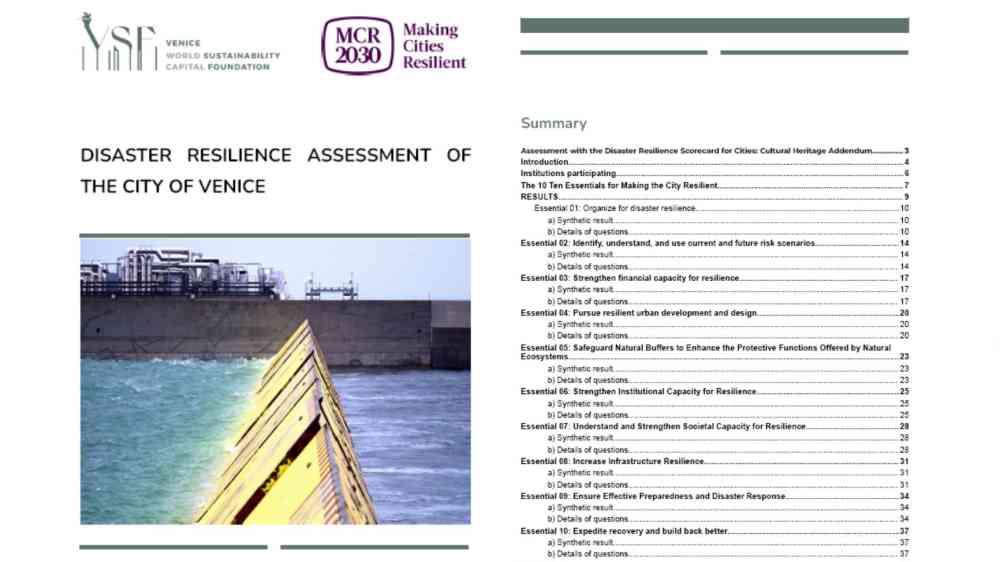
Venice has taken a significant step in strengthening the resilience of its cultural heritage with the publication of the Disaster Resilience Assessment of the city of Venice. This report is the outcome of a workshop held in July 2024, organized by the Venice Sustainability Foundation (VSF) in collaboration with the UN Office for Disaster Risk Reduction (UNDRR) Regional Office for Europe and Central Asia and CORILA (Consorzio per il coordinamento delle ricerche inerenti al sistema lagunare di Venezia).
Developed in close consultation with UNDRR, the report provides a comprehensive assessment of Venice’s cultural heritage resilience, identifying key vulnerabilities and opportunities to enhance disaster risk reduction (DRR) strategies. Using the MCR2030 Disaster Resilience Scorecard for Cities: Cultural Heritage Addendum, participants—including local authorities, cultural institutions, and DRR experts—evaluated current risk management approaches and proposed actions for strengthening resilience.
Key Recommendations
The report highlights several key recommendations to enhance the resilience of Venice’s cultural heritage, including:
- Enhancing data collection and risk assessment to improve understanding of vulnerabilities and potential threats.
- Integrating cultural heritage protection into disaster risk reduction (DRR) strategies and broader city resilience planning.
- Strengthening multi-stakeholder collaboration, ensuring ongoing dialogue between local authorities, cultural institutions, and disaster risk experts.
- Developing tailored emergency response and recovery plans for cultural heritage sites, considering both rapid-onset hazards and long-term climate risks.
- Increasing investment in preventive measures to safeguard both tangible and intangible heritage from disasters.
The Venice Municipality has endorsed the report, and a follow-up consultation will take place in the coming months to facilitate knowledge exchange with other cities. These findings serve as a valuable resource for cities worldwide aiming to protect their cultural heritage while building resilience to disasters.